|
|||
| BEIJING | <Search <Archives <eBulletin | ||

May 9, 2008 Beijing's new luxury hotel The Opposite House to open in mid 2008 Beijing抯 new luxury hotel, The Opposite House, the first of a series of unique hotel properties from newly formed Swire Hotels, were designed by celebrated avant-garde architect Kengo Kuma from Japan; and Lyndon Neri and Rossana Hu, partners of Shanghai-based international design firm Neri and Hu Design Research Office (NHDRO).
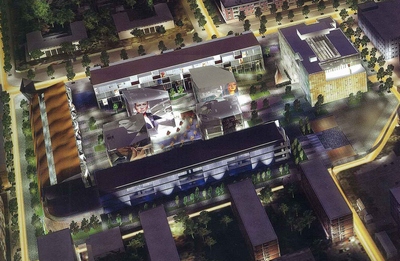
Kuma redefines conventional architectural boundaries to create seamless flowing spaces flooded with light. The hotel抯 exterior, a striking emerald glass, is in keeping with the stunning glass exteriors of The Village at Sanlitun, Beijing抯 premier open-plan shopping and entertainment destination, of which The Opposite House is an integral part. Interior colours and textures at The Opposite House are a vivid mix of the modern and the traditional. As the hotel borders both a busy nightlife neighborhood and quiet residential area, the exterior is stunning and vibrant, while the interior is soft, securing privacy and comfort. An overall green colour scheme, the calm of an urban forest, for which one of the most important design elements is the play of natural and artificial light. A small luxurious contemporary hotel is a very interesting balance of private and public. It has to offer hideaways with the comfort of home, yet at the same time create vibrancy where people flow through public spaces. To create this fine, delicate balance we softened the demarcation of each space.
Among the hotel抯 many striking features, a stainless-steel-clad swimming pool is designed to dramatically reflect both natural light and exciting fibre optic lighting.
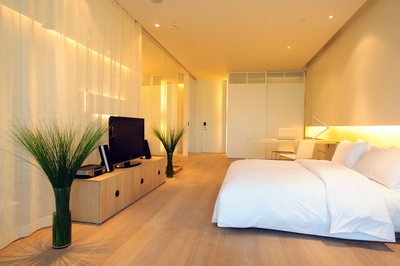
Guest rooms meanwhile are strikingly open and simple with natural brushed oak floors, furniture and even bathtubs, with subtle touches of Chinese decor to evoke a sense of place in Beijing. The restaurants, meeting area and 搈ini club� were styled by NHDRO. When confronted with an empty concrete shell on the basement level, initial approach was to break the large cavernous space into five distinct yet related and interactive spaces, different materials closely associated with the five elements were utilised to make them stand out from each other. From an elevator, guests first enter 慣he Egg�, stepping through a dark bronze threshold into pure white space. A steel floor reflecting an overhead elliptical dome gives the visitor a sense of floating. The message, as the designers explain, is 搕he beginning of life and an epiphany for the weary and tired. Solemn and serene, 'The Egg' provides rest for the eyes before transition into the decadent destination points.
The theme is also adopted through a secondary entrance down a concrete flight of stairs, leading to an outdoor 慡unken Garden�, thick with bamboo and water features, creating small gathering spaces to wait for friends, order a coffee, or dine alfresco. The garden is adjacent to Mediterranean restaurant Sureno, with warm woods and blue olive grove patterns. Entering neighbouring Asian restaurant Bei, guests are surrounded by a forest of trees before entering a 慶learing� and the dining room, where a large mirror allows patrons to watch chefs in action. Beyond, five white 揵oxes� house private dining rooms, with a sense of allure and secrecy, entered through large bronze doors and across water channels. Each room has its own character and richly appointed furniture. In the largest, water streams down the walls. The vision is "total privacy and exclusivity without compromise". In contrast, Punk opposite - a late night bar and mini club - is a solitary transparent box, seemingly sunken, wrapped by a rough, punched metal screen. Wooden church pew like benches hug the walls, juxtaposed modular tables are scattered throughout, clean smooth concrete bar tops, angular and fluid Grcic stools and offbeat burnt Maarten Baas chandeliers create a mood of righteousness as well as wickedness, rough and smooth, parochial and worldly, cool and warm, and ultimately luxury and punk.
As NHDRO puts it: 揥e think that the most important feature of this project is the spatial quality of the area seen as a whole, as opposed to one individual destination. The entire project is treated as a continuous amalgamation of distinct spaces together with a network of public spaces binding them all together - a city within a city. The Opposite House, an intriguing urban hotel will open in the summer of 2008 in Beijing抯 vibrant Sanlitun district, an integral part of The Village at Sanlitun, Beijing抯 premier open-plan shopping destination, developed by Swire Properties.
|
|
|