|
|||
| MACAO | <Search <Archives <eBulletin | ||

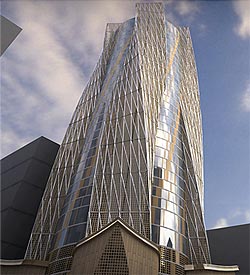
May 6, 2008 Jade Entertainment Complex Located in the heart of Downtown Macau, the Jade Entertainment Complex sits in a densely developed urban fabric where the recent pace of development has pushed up land values exponentially. The small site is a 50 m x 50 m square above ground, with extended borders below grade. The developer’s multi-use program calls for entertainment venues, casino gaming, parking, restaurants, hotel, condominium and adjoining amenities. With the size and relative mix of each component imminently tied to the economic viability of the project, the first challenge was to aggregate the multiple program elements effectively on the site. Sustainability
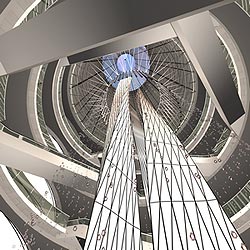
The central atrium and perimeter core configuration allows for a naturally convecting heat and cold cycle by taking advantage of the most abundant resources available to this building; height and pressure differentiation. During the summer months, the cooling cycle involves drawing cool, high altitude air into and down the core shafts where it is circulated and humidified in the public space by the rain fountain/ feature located at the bottom of the atrium. This air is then drawn up and out the top of the atrium through the self-actuating skylight using Bernoulli’s principle of fluid dynamics. The cycle is reversed for the heating cycle. Air is warmed under the self-actuating skylight, the only location with constant solar exposure in the building. This warmed air is drawn down the atrium into the public space before being pulled back up and exhausted from the core shafts, again through the stack effect. These strategies substantially reduce the mechanical load and power consumption of the project.
By exploiting the unique problems of economy, program, site, structure and environmental control, this project radicalizes normative, parceled building systems and intertwines them into a singular breathing organism. This strategy signifies a shift from the 20th century iconographic tower, into a more significant architecture specific to its unique position and circumstance.
Steelman Partners has received two awards at the American Institute of Architects (AIA) “Excellence in Design” Awards 2007 ceremony held in October 2007. Both the AIA Unbuilt Category Citation Award and the AIA People’s Choice Award marks AIA’s recognition to Steelman Partners for the firm‘s design of the unbuilt Jade Entertainment Complex.
architect
Steelman Partners
designer
Paul Steelman, AIA, and Michael Vihn
area
80,300 sq m
completion date
2010
|
|
|