April 1, 2008
Route 8 Kowloon-Sha Tin link opened
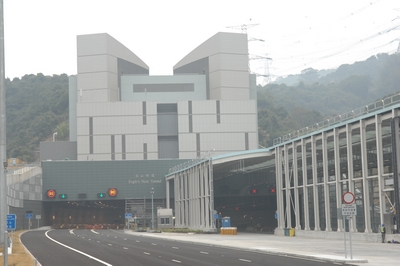
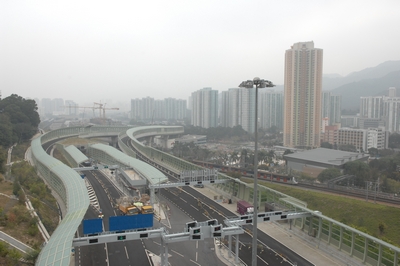
The 5.9 km Route 8 Cheung Sha Wan to Sha Tin section opened to traffic in March 2008, cutting journey time between Sha Tin and Tsim Sha Tsui by 15 minutes. Highways Department Major Works Project Management Office Chief Engineer Michael Hui said the new dual three-lane road will be Hong Kong's fourth link between Sha Tin and Kowloon, comprising the Eagle's Nest and Sha Tin Heights Tunnels and the Lai Chi Kok Viaduct.
The existing three links - the Lion Rock and Tate's Cairn Tunnels and Tai Po Road - are always congested. January saw 2.82 million cars use the Lion Rock Tunnel and 1.77 million use the Tate's Cairn Tunnel, up 8,500 and 60,900 vehicles on the same month last year.
The new link, costing HK$5 billion, can cater up to 120,000 vehicles a day. As the Tsing Sha Control Area will, same as the Lion Rock Tunnel, adopt a flat rate of HK$8 for all vehicles, the new link can help divert traffic from the existing ones and improve traffic flow.
To cater for traffic growth brought by the new link, Road T3 will open at the same time while roads in Tai Wai have been upgraded to avoid traffic jams.
Works on the 1 km Sha Tin Heights Tunnel started in November 2002. It comprises twin horseshoe shaped tubes of about 16 m in width and 9 m in height, with approaches linking Road T3 and Che Kung Miu Road.
In October 2003 the department started building the 2.1 km Eagle's Nest Tunnel comprising twin horseshoe shaped tubes measuring 15 m wide and 10 m high. It is the longest dual three-lane government tunnel.
Between these two tunnels is a toll plaza with 18 tollbooths and an administration building. Bus lay-bys of 100 m in length on each side of the plaza have been built for bus interchange.
For the 1.4 km Lai Chi Kok Viaduct works started in September 2003. Its bridge deck rises up to 45 m from ground level and the span length varies from 45 m to 80 m.
Both tunnels, with a speed limit of 80 kph, are equipped with ventilation, lighting, and traffic control and surveillance facilities. Cross passages between tunnel tubes at 100 m intervals are provided for emergency evacuation to the adjacent tube. Apart from closed-circuit televisions and smoke detectors, the department has also installed for the first time linear heat detectors throughout the tunnels as one of the fire protection facilities.
Planting works have been conducted along the route, including 1,550 trees, 70,000 whip trees and 375,000 shrubs. The roof of the noise enclosure on the Sha Tin Heights Tunnel approach serves as a landscaped deck with extensive planting while climbers will be planted at noise barriers in Butterfly Valley to make them blend with surroundings. An earth mound - a recycled plastic structure filled with soil for growing plants to cut noise - has been built near the administration building at the toll plaza.
Planters have been built along some sections of the Lai Chi Kok Viaduct for growing flowering plants, such as yellow ixora, lantana camara, chulan tree and azalea to green the link. We have also upgraded the stream in Butterfly Valley making it more appealing to birds and fish.
The new route passes underneath Kowloon Reservoir and water pipes there posed challenges to engineers. There were many water pipes near Eagle's Nest Tunnel, with the nearest one just 10 m away from the tunnel. Good tunnelling techniques and close monitoring were key to ensuring the pipes were not affected by the tunnel construction.
It took construction workers 30 months to break through the two tunnels resulting in one million tonnes of excavated rocks.
To avoid adding pressure on public landfills, all the excavated rocks have been recycled with those of better quality sent to Tsing Yi for making concrete while others will be used as fill materials in works projects.
The construction of Lai Chi Kok Viaduct was also not an easy task as it runs via the busy West Kowloon Highway, Lai Chi Kok Road, Cheung Sha Wan Road, Castle Peak Road and Ching Cheung Road where many utility pipes are underground.
To keep people and traffic moving without affecting underground facilities a well-thought-out plan and state-of-the-art construction techniques helped us achieve the target.
The viaduct was designed with long spans and the bridge deck built with pre-cast segments to cut traffic disruption. The department installed the segments at night with full compliance with environmental noise controls.
Lai Chi Kok Viaduct joins Ngong Shuen Chau Viaduct at Lai Wan Interchange forming a five-layered highway structure, the most complicated one in the city.
The structure comprises Lin Cheung Road as the first layer, a road overpassing it is the second, West Kowloon Highway is the third, the new ramp from Ngong Shuen Chau Viaduct to West Kowloon Highway is the fourth, and the new mainline from Lai Chi Kok Viaduct to Ngong Shuen Chau Viaduct is the fifth.
For the Route 8 Tsing Yi to Cheung Sha Wan section, 70 per cent of the works on Stonecutters Bridge have been completed. The bridge towers will be 298 m high. The East Tower now reaches 273 m and the West Tower 230 m, both higher than the Tsing Ma Bridge towers.
|
|